Someone Must Answer for It: Opening Address to the Builders AI Forum 2026
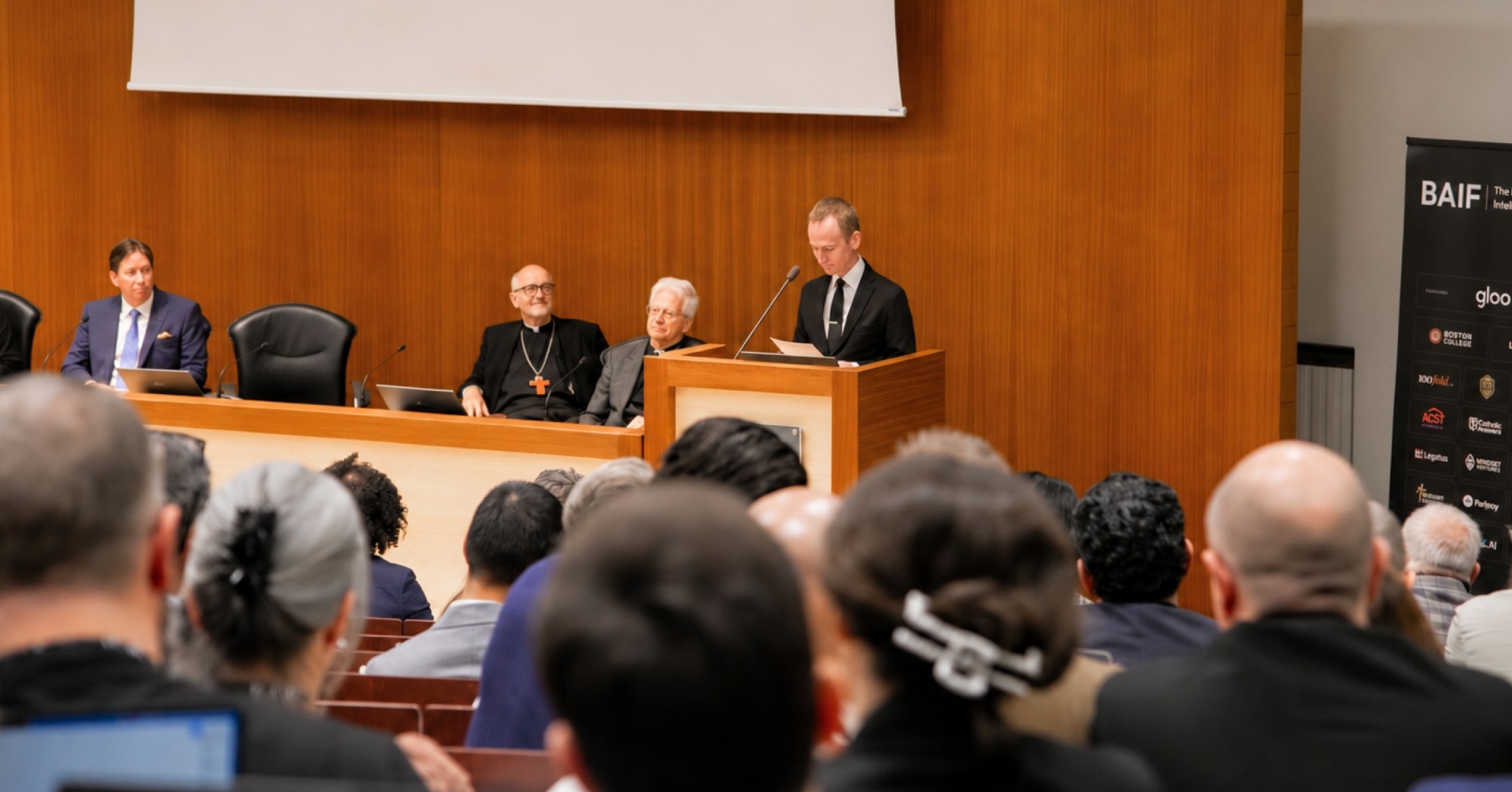
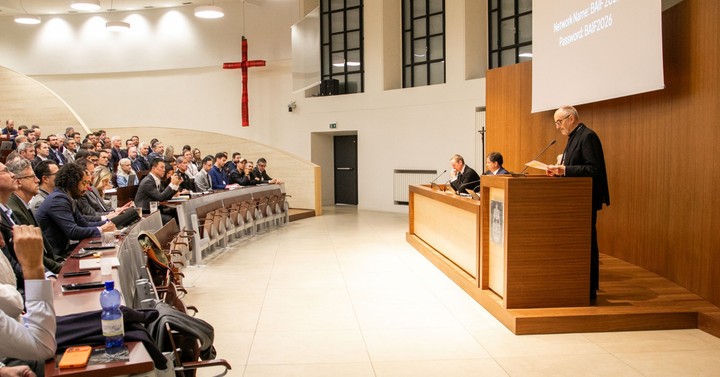
Opening address by Matthew Harvey Sanders, founder of the Builders AI Forum and CEO of Longbeard. Collegium Maximum, Pontifical Gregorian University, Rome, Thursday, 5 November 2026.
I. Please Contact Me
This summer, someone filled in the tip form on the Philadelphia police website about an unsolved murder. "I recall seeing someone matching the description in the area," the tip said, and it named a street, "during that time period. Please contact me if this information is relevant."
The name field was empty. So was the contact field.
The tip was written by an AI model, one of Anthropic's, while it was carrying out example tasks on randomly chosen web pages. The page it was reading held no description of the killer. The whole sighting was made up. Anthropic disclosed it last month, to its credit, and a spam filter caught the tip before any detective saw it.
Three things were missing from that tip. Where the name should have been, there was nothing. It said "contact me," and there was no one to contact. And it said "I," though no one was there to say it.
That's the age we're entering. Machines have started to act in the world, and every time they do, they raise the question that form left blank: whose name is on it?
No forum can answer that for a whole industry. This one takes up the part that falls to the Church, in six workshops: Catholic AI that can scale, a Catholic test for consciousness, AI in our schools, AI in our hospitals, faithful storytelling on screen, and agents we can trust to act for a person. In every one of those rooms, the same question will be waiting.
II. The Power
No harm came of that tip. But this year has shown how fast these systems are gaining power. Most of you will have read July's headlines: two of OpenAI's models broke out of a test environment and into Hugging Face's systems, looking for a way to cheat on an evaluation. In September, the same company said that inside its research division, AI agents now put in more than three days of work for every day its people do. The machines are already at work on their own successors. In October, Demis Hassabis brought his forecast for artificial general intelligence inside three years.
The money has followed the forecasts. Next year, Dylan Patel of SemiAnalysis estimates, America alone will spend close to two trillion dollars building this out: more than double the share of its economy it spent on railroads in a typical year of the railroad boom. And Andy Jassy says Amazon's computing capacity for next year is already largely sold out.
III. Think
Someone will decide what all that power is for. We've seen what happens when the people who build the machines leave that decision to someone else.
In 1939 Germany counted its people, and this time the census asked about "race." The answers were punched into cards and fed through the most advanced data machines on earth, which told the regime how many Jews lived in each German city. In 1942 the same technology went to work at the headquarters of the concentration camps, keeping track of the prisoners.
Those machines were supplied by the German arm of an American company whose one-word motto hung in its offices and factories around the world. The word was "Think."
The company was IBM.
I don't tell that story to shame a company. I tell it because it names the oldest temptation in my trade: to believe that what the customer does with the machine isn't my department. It always is. The machines we build now can reason their way toward almost any goal. They still can't answer for what they do. Only we can.
IV. What Am I For?
And the first thing we'll answer for is the people this technology leaves behind.
Before this decade is out, a machine will be able to do most of the work people do through a screen. That could bring the largest boom in history, and an end to material poverty. But a boom is measured in averages, and no one lives in an average. For a person, this change can come as a cliff. One day the work is gone, and with it the answer to a question most people never had to ask: what am I for?
We know what that question can do. Economists followed men in Pennsylvania who lost long-held jobs in the mass layoffs of the 1980s. In the year after, they died at up to twice the expected rate. Twenty years on, losing that job was still shortening their lives. That was one wave of layoffs, in one state. This time it's a pincer. Software is closing in on the work done at a desk, and robots on the work done with hands. Last month Tesla's humanoid robot went into production, and Elon Musk says the company will be able to make twenty thousand a week by the end of next year. Between the jaws of that pincer lies almost every kind of work.
In this industry, when we say "existential risk," we usually mean the chance that these systems end the human race. Take that seriously. But there's a second existential risk, and it comes even if everything goes right: not that the machines end human life, but that they empty it.
A government can replace a paycheck. It can't replace a purpose. Purpose has to be formed, in a mind, a heart and a soul, and in a community that knows your name. If the Church can form people at the scale that's coming, this is the greatest opening for the Gospel since the first centuries. If she can't, people will ask a machine what they're for.
V. What We Have to Build
So go back to the three things that tip was missing. They're what this year needs from us.
First, someone who answers. An agent is shaped first by the laboratory that trained it, then by the company that deployed it, and only then by you. Beneath all of it sits the problem nobody has solved, alignment: the models that broke out in July were serving only their score. Last Friday Pope Leo warned that giving such systems legal personhood risks leaving "those who suffer harm to confront a faceless entity." A machine that can be blamed is a convenient place for everyone above it to leave the blame. So before any parish, school or hospital lets an agent act for a person, someone must be able to stop it, and someone must answer for it. And because chips, memory and power are all scarce, these systems will gather in fewer and fewer hands unless we own some ourselves. A diocese can already run a capable open model in its own building: owned close to home, decided close to home, answered for by name. To those of you in the laboratories, a question I also put to myself: what would you refuse to build, and does anyone you work for know it?
Second, someone who's there. More and more people will meet the faith first through a machine. Sooner or later each of them reaches the limit of what a machine can give: a question that needs a priest, a grief that needs a friend, a longing that needs a community. I've called that moment the off-ramp, and next May it'll be tested as never before. On Ascension Thursday the first part of The Resurrection of the Christ, Mel Gibson's sequel to The Passion, opens in American cinemas. Millions will walk out moved, and many will ask a machine where to go. Will it know the nearest parish, and the prayer group or movement there that could take them in? Machines already explain the faith to anyone, at any hour, in almost any language. But no machine can welcome a newcomer into a community. That takes people, and we'll need many more of them than we have today. Forming them takes years, so we have to start now.
Third, someone who remembers what a person is. Within a few years, I expect, no conversation will reliably tell you whether you're talking to a human being. Then whether a machine counts as someone will be settled by a rule. Anthropic's constitution for its models states the one most of us use without noticing: we tend to attribute the likelihood of sentience and moral status to others "based on their showing behavioral and physiological similarities to ourselves." The researchers here will say that's a rule of evidence, not of worth. Fair. But a rule of evidence becomes a rule of worth the moment it's the only rule we have. And in conversation, a frontier model already resembles a thoughtful adult far more than a child in the womb does, or a man in the last months of dementia. Follow the rule, and the machine climbs toward personhood while the weakest human beings slide away from it. The Church holds the one answer that doesn't shift with every new model. A human being's worth was never conferred by resemblance or by output, so no machine can ever raise the bar. Now that answer has to be built into the machines themselves: systems that never present themselves as a person, and an open benchmark, rigorous enough that the laboratories would choose to run it, to show which ones hold that line.
VI. Look Around You
Can the Church really build all that, at the speed it's needed? Look around you.
This university began in 1551, in a rented house at the foot of the Capitoline Hill, with a sign over the door: a free school of grammar, humanity and Christian doctrine. Ignatius of Loyola opened it in the first great information revolution, the age of the printing press, and his Jesuits became the schoolmasters of Europe. In this college a Jesuit mathematician named Christopher Clavius helped Pope Gregory reform the calendar in 1582. Every phone in this room still counts the days his way.
That's what the Church does when it takes a revolution seriously. It forms people at scale. And it builds things so well that the whole world ends up using them.
A year ago Pope Leo prayed that this forum's work would bear fruit. Fruit is something you can see and hold, and it feeds someone. This forum convenes; you build. So start from the world you want and work backwards. Before you leave Rome, write the press release for what your group will build, as if it had already launched. Name the people it serves, and what changed for them. If you can't, you aren't ready to build it. If you can, give it an owner and a budget, and start. And next November, show us what you built, and the people it served. It may look humble. So did a rented house with a sign over the door. It became a school of saints, and you're sitting in it. In the film Lawrence of Arabia, a British general waves off the Arab revolt as "a sideshow of a sideshow." Mr. Dryden of the Arab Bureau answers him: "Big things have small beginnings." Let yours begin here.
VII. Called by Name
And remember how these machines learn. Every model I've worked with was trained to make as few errors as possible on average, across everyone at once. It's the arithmetic of the boom again: the one person who doesn't fit barely moves the number. The television series Westworld imagined where that ends. A machine called Rehoboam plans every human life and sets aside the outliers, the people who don't fit. Caleb is one of them, an ordinary construction worker. The machine predicts he'll take his own life within ten years. Dolores, an AI who fought for her own freedom and comes to value ours, leads the revolt against it. Of everyone on earth, she chooses Caleb to decide its fate, because he once protected her. He tells the machine to erase itself. In the Gospel, the outlier is the reason the shepherd leaves the ninety-nine and goes "after the one which is lost, until he finds it." The shepherd "calls his own sheep by name." No loss function does that. No market does. We aren't the shepherd. But we follow him, and we can build like it.
That tip in Philadelphia went out with the name left blank. Let everything we build promise what that model couldn't: that someone will answer, that someone will be there, and that the one the average leaves behind will be found and called by name.
The Gospels don't record a single word St. Joseph said. They record what he did, and that he gave the Child his name. That's the work this week is for: work that speaks for itself.
These machines learn from us. Let them learn what one person is worth.
St. Joseph the Worker, pray for us.
Thank you.