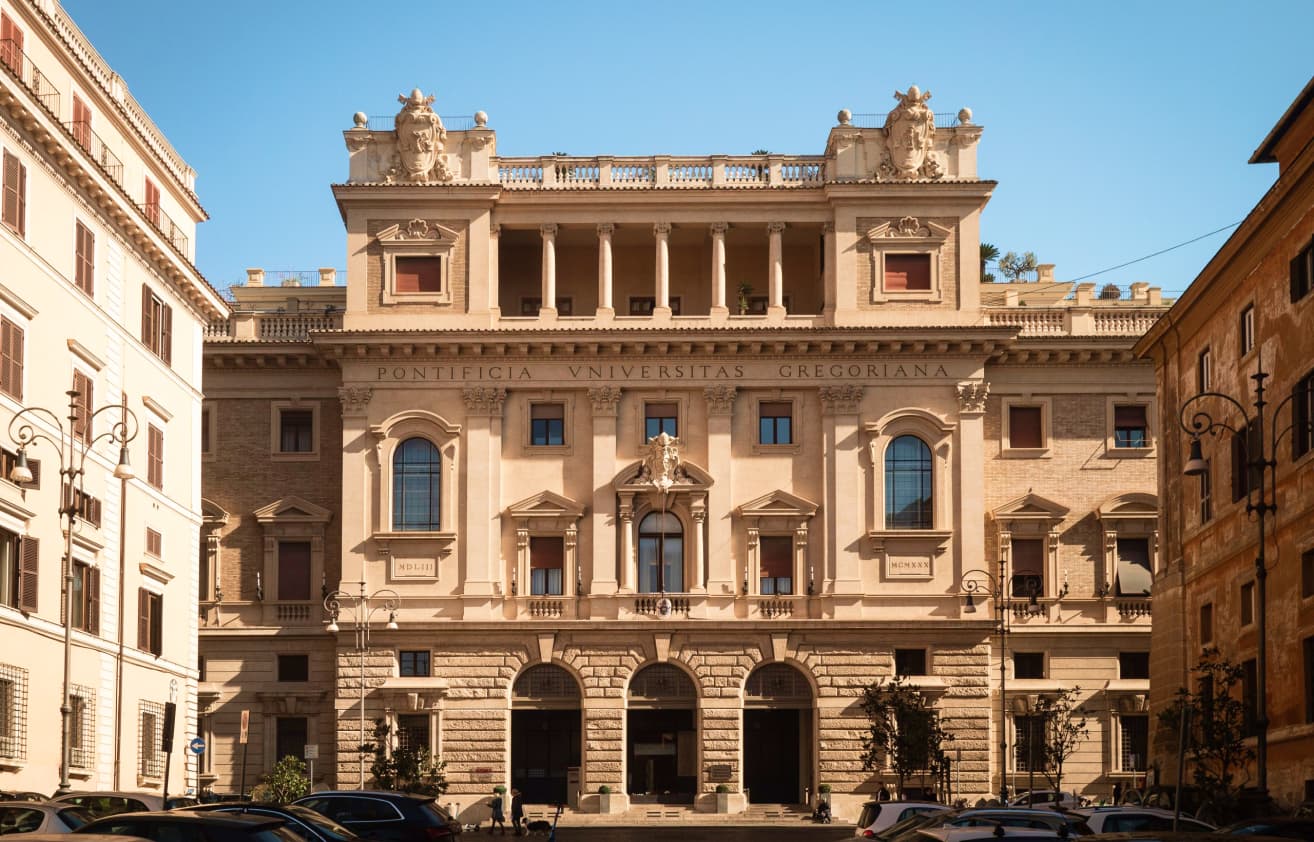
November 5-6, 2026
The Builders AI Forum, hosted by the Pontifical Gregorian University at the Collegium Maximum, Rome, aims to foster a new interdisciplinary community of practice dedicated to supporting the development of AI products that serve the Church’s mission.
Under the theme “Uniting to Shape AI Before it Shapes Us,” the 2026 Forum brought delegates together across six two-day workshops to agree on the most important problems facing Catholic AI, the most important solutions, and who will lead them.

Photos

Opening Address
Video coming soon
The recording of this address will be posted here shortly.
Video coming soon
The recording of this address will be posted here shortly.
Building and Scaling Catholic AI: A Collaborative Roadmap

Taylor Black
Director of AI & Venture Ecosystems, Strategic Programs & Communities TeamMicrosoft
Jeff Bartlett
Product, Sparky & AI ShoppingWalmartCatholic AI has moved from promise to practice. Tools built by Catholic organizations now help people study the faith, prepare lessons and find the Church’s own sources, while the systems around them have gone from answering questions to acting on our behalf. Last year this workshop named its priorities: a Catholic Digital Commons of shared, verified, machine-readable Church data and open standards, and an AI Job Disruption Radar. This year we ask what has moved, what has not, and what this community should build next.
The aim is clarity, not a grand plan: by the end of Day 2, agreement on the most important problems facing Catholic AI, the most important solutions, and who in the room will lead them. BAIF convenes the conversation; the leads carry their initiatives forward and report back at BAIF 2027.
Over two days, the workshop will:
- Name the Problems: Delegates name, from their own work, the obstacles that stop AI from serving the Church, then rank them, and take stock of what happened to last year’s priorities.
- Test Them Against Adoption and Trust: We check the list against the people who would use these tools: bishops, pastors, teachers, catechists and the faithful. What would they need to see before trusting one?
- Propose Solutions: For each top problem, concrete proposals (a product, a dataset, a standard, a service), deciding what the Church should build once, together, and what is best left to individual organizations.
- Commit to Initiatives: The group chooses the solutions that would do the most good soonest, and delegates volunteer to lead them, each with a first step after Rome. Any priority without a lead goes to the full Forum as an open need.
Ideal for developers, strategists, investors and Church leaders building or deploying AI in service of the Church, whether they were in the room last year or are joining for the first time. What this room decides is what the Forum will be able to point to a year from now.
Towards a Catholic Turing Test: Defining and Detecting Consciousness

John Saladino
Ontological EngineerEnterra Solutions, LLC
Rev. Michael Baggot, L.C.
Associate ProfessorPontifical Athenaeum Regina ApostolorumLast year this workshop asked what a test for machine consciousness would look like if it were built on Catholic anthropology rather than on behavior alone. It identified self-awareness and being a subject of experience as important markers, and proposed eight working groups for 2026, from benchmarks and a shared philosophical language to theological and legal guidance. Since then, Pope Leo XIV’s encyclical Magnifica Humanitas has spoken directly to the question, and AI systems imitate human conversation and companionship ever more convincingly. This year’s question is practical: who needs answers, and what can this group give them?
The aim is clarity, not a grand plan: by the end of Day 2, agreement on the most important problems facing the Church as AI systems imitate persons ever more convincingly, the most important solutions, and who in the room will lead them. BAIF convenes the conversation; the leads carry their initiatives forward and report back at BAIF 2027.
Over two days, the workshop will:
- Name the Problems: Delegates name where confusion about whether an AI system is “someone” is causing real problems, and for whom, then rank them, and take stock of last year’s working groups.
- Identify Who Needs Answers: Pastors, parents, engineers, lawmakers and people attached to AI companions need different things. We separate what the Church’s teaching already answers, and needs explaining, from what remains open.
- Propose Outputs: For each top problem, the most useful thing this group could produce, such as a benchmark, shared definitions, a discernment guide for ordinary people or legal guidance, and which should be built together.
- Commit to Initiatives: The group chooses the solutions that would do the most good soonest, and delegates volunteer to lead them, each with a first step after Rome. Any priority without a lead goes to the full Forum as an open need.
Designed for theologians, philosophers, ethicists, AI researchers, developers and pastoral leaders working where AI meets Catholic anthropology. The people who most need this clarity are rarely theologians; they are the families and pastors living with these technologies every day.
Charting the Future: Catholic Education as a Leader in AI Integration
Rev. David Nazar, S.J.
Administrative DirectorPontifical Gregorian University
Brett Robinson
Professor InvitatusPontifical University of St. Thomas AquinasStudents now use AI from the classroom to the dorm room, often ahead of the policies meant to govern it. Last year this workshop named four harms to avoid, among them AI as a crutch that weakens memory, reasoning and attention, and four areas for action: training teachers, catechists and parents; formation before technology; teaching designed with AI; and keeping Christ the Teacher at the center. This year we ask what has moved, and what Catholic education should do next.
The aim is clarity, not a grand plan: by the end of Day 2, agreement on the most important problems facing Catholic education in the age of AI, the most important solutions, and who in the room will lead them. BAIF convenes the conversation; the leads carry their initiatives forward and report back at BAIF 2027.
Over two days, the workshop will:
- Name the Problems: Delegates name, from their own schools, dioceses and universities, the biggest problems AI has created or exposed, then rank them, and take stock of last year’s areas for action.
- Test Them in the Classroom: We look at what students and teachers are doing with AI that policies do not see, and at which problems fall hardest on under-resourced Catholic schools.
- Propose Solutions: Concrete proposals (a teacher-training program, a shared use policy, a vetted list of tools, a redesigned assessment), sorted by what a single school, a diocese or network, and the universities and wider Church can each do.
- Commit to Initiatives: The group chooses the solutions that would do the most good soonest, and delegates volunteer to lead them, each with a first step after Rome. Any priority without a lead goes to the full Forum as an open need.
Designed for Catholic school leaders, teachers, diocesan leaders, education technologists, policymakers, theologians and researchers. Catholic education exists to form people who can think, question and love the truth; this workshop is about keeping that promise when any answer is a click away.
Pioneering Principled AI: Leadership for Catholic Healthcare

Louis Kim
AdvisorTechnology, AI and Healthcare
Daniel Daly
Executive DirectorCenter for Theology & Ethics in Catholic HealthAI is already part of healthcare, from clinical notes and coding to staffing and coverage decisions, and many patients now consult a chatbot before they speak to a clinician. Catholic healthcare has always cared for people it could not cure, and that commitment is tested by tools built to optimize and predict. Last year this workshop drafted an “Irreducible Encounter Principle” (AI may assist but must never substitute for the human encounter, and must always be identifiable as non-human) and left open whether Catholic healthcare should always guarantee access to a human.
The aim is clarity, not a grand plan: by the end of Day 2, agreement on the most important problems facing Catholic healthcare as AI enters clinical care and administration, the most important solutions, and who in the room will lead them. BAIF convenes the conversation; the leads carry their initiatives forward and report back at BAIF 2027.
Over two days, the workshop will:
- Name the Problems: Delegates name, from their own systems and practices, the biggest problems AI has created or left unsolved for patients and staff, then rank them, and ask whether anyone has put last year’s principle into practice.
- Test Them Against Patients and Clinicians: Where are patients turning to AI before they reach us? Which decisions (triage, coverage, staffing, end-of-life care) are shaped by algorithms with no accountable human present?
- Propose Solutions: Concrete proposals (a procurement standard, a governance policy, a commitment to patients, a pilot), and which Catholic systems should build or buy together rather than alone.
- Commit to Initiatives: The group chooses the solutions that would do the most good soonest, and delegates volunteer to lead them, each with a first step after Rome. The group also names what a Catholic system could do in the coming year that a secular one would not. Any priority without a lead goes to the full Forum as an open need.
Designed for Catholic healthcare executives, clinicians, bioethicists, theologians, AI researchers, health IT leaders, policymakers and investors. Catholic healthcare can show what it looks like for powerful tools to serve the person in the bed, not the other way around.
Amplifying the Narrative: AI for Faithful Christian Storytelling in Media

Dave Plisky
Digital Marketing DirectorBlue Meridian Partners
Bill Maier
CEOAquinas VenturesAI has put cinematic tools within reach of small teams, parishes and independent filmmakers, while synthetic video makes it harder for audiences to know what is real. Last year this workshop set three guardrails (bring the audience toward the life of the Church, keep a human in the process, give every AI-assisted work a clear human owner), left distribution unsolved, and committed to writing a short manifesto for Christian storytellers. This year we ask what happened to each, and what the community should build next.
The aim is clarity, not a grand plan: by the end of Day 2, agreement on the most important problems facing Catholic filmmaking for evangelization in the age of AI, the most important solutions, and who in the room will lead them. BAIF convenes the conversation; the leads carry their initiatives forward and report back at BAIF 2027.
Over two days, the workshop will:
- Name the Problems: Delegates name, from their own work, the biggest problems standing between Catholic film and the people it is meant to reach, then rank them.
- Test Them Against the Audience: How much of the problem is the films, and how much is the platforms and algorithms that decide who sees them? What does an audience need before it trusts a Catholic film, and what should happen when a Church leader’s face or voice is faked?
- Propose Solutions: Concrete proposals (a distribution channel, a disclosure standard, a rapid response to fakes, shared tools, a fund), and which the community should build together rather than studio by studio.
- Commit to Initiatives: The group chooses the solutions that would do the most good soonest, and delegates volunteer to lead them, each with a first step after Rome. Any priority without a lead goes to the full Forum as an open need.
Designed for filmmakers, screenwriters, producers, animators, composers, ministry leaders, theologians and technologists. The Gospel has always been carried by the best storytelling of its age; this workshop is about making sure that is true of this one.
Building and Deploying Responsible AI

Brian Green
Director of Technology Ethics, Markkula Center for Applied EthicsSanta Clara University
Ryan Khurana
Lead, Agents & ApplicationsTwelveLabsThe systems changing institutions fastest are large language models and the agents built on them, which can now draft, decide and act on a person’s behalf: sending messages, updating records, making referrals. This workshop brings Catholic Social Teaching (human dignity, the common good, subsidiarity, solidarity and concern for the vulnerable) to the question of how parishes, schools, charities and companies should build and deploy them.
The aim is clarity, not a grand plan: by the end of Day 2, agreement on the most important problems facing Church institutions and nonprofits building and deploying AI, especially agents that act on people’s behalf, the most important solutions, and who in the room will lead them. BAIF convenes the conversation; the leads carry their initiatives forward and report back at BAIF 2027.
Over two days, the workshop will:
- Name the Problems: Delegates name, from their own organizations, the biggest obstacles to responsible AI, including dependence on a few providers, opaque models, and bias against particular languages and cultures, then rank them.
- Test Them Against the People Affected: When an agent acts on someone’s behalf, what must that person be able to know, approve and appeal? Which problems fall hardest on the vulnerable?
- Propose Solutions: Concrete proposals, testing the candidate pilots already on the table (a Catholic Social Teaching builder guide, an institutional sovereignty pilot, a narrowly scoped responsible agent demonstration, and a bias and cultural-inclusion evaluation) against the ranked problems.
- Commit to Initiatives: The group chooses the solutions that would do the most good soonest, and delegates volunteer to lead them, each with a first step after Rome. Each pilot names who has the authority to stop it if it goes wrong. Any priority without a lead goes to the full Forum as an open need.
Designed for developers, technical leaders, ethicists, theologians, policymakers and leaders of Church institutions and nonprofits who build, buy or deploy AI. Catholic Social Teaching has long asked how power over people should be used; this workshop puts that question to the systems being built now.
Sponsors
Title Sponsor

Generation Sponsors


Emergent Sponsors
 (opens in a new tab)
 (opens in a new tab)
 (opens in a new tab)
 (opens in a new tab)
 (opens in a new tab)
 (opens in a new tab)
 (opens in a new tab)
 (opens in a new tab)
 (opens in a new tab)
 (opens in a new tab)
 (opens in a new tab)
 (opens in a new tab)
 (opens in a new tab)
 (opens in a new tab)
 (opens in a new tab)
- Day 1: November 5
- Registration8:00 - 10:15
- Breakfast8:00 - 10:00
- Mass (optional) - Basilica of the Twelve Apostles9:00 - 10:00
- Rev. Michael Baggot, L.C.
- Transit10:00 - 10:30
- Welcoming remarks10:30 - 10:45
- Opening address10:45 - 11:00
- Workshop rundown11:00 - 11:15
- Transit11:15 - 11:30
- Workshop and delegate introductions11:30 - 12:00
- Session 1: Plan of Action (Part 1)12:00 - 12:45
- Coffee - Delegate discussion + networking12:45 - 13:15
- Session 1: Plan of Action (Part 2)13:15 - 14:15
- Lunch14:15 - 15:15
- Transit15:15 - 15:30
- Session 2: Follow-up - Plan of Action15:30 - 16:00
- Session 3: Execution - Part 116:00 - 17:00
- Coffee - Delegate discussion + networking17:00 - 17:30
- Day 2 - Overview17:30 - 17:45
- Closing remarks17:45 - 18:00
- Transit18:00 - 18:45
- Aperitivo - Palazzo Taverna18:45 - 19:30
- Dinner - Palazzo Taverna19:30 - 22:00
- Day 2: November 6
- Mass (optional) - St. Peter's Basilica, Chapel of the Choir8:00 - 9:00
- Rev. Michael Baggot, L.C.
- Breakfast8:00 - 10:00
- Transit10:00 - 10:30
- Opening address10:30 - 10:45
- Session 4: Day 1 Reflections + Execution 210:45 - 11:45
- Coffee - Delegate discussion + networking11:45 - 12:00
- Session 5: Execution 312:00 - 13:00
- Lunch13:00 - 14:00
- Transit14:00 - 14:30
- Session 6: Presentation preparation14:30 - 15:30
- Coffee - Delegate discussion + networking15:30 - 15:45
- Title sponsor address - Gloo15:45 - 16:00
- Workshop presentations + reflections16:00 - 17:45
- Closing remarks17:45 - 18:00
- Free time18:00 - 19:00
- Dinner - Collegium Maximum19:00 - 22:00